






If your business still creates an invoice in Excel or Word, converts it to PDF, and emails it to the customer, your invoicing process may need a significant change.
The UAE is moving from conventional invoice documents toward a structured electronic invoicing system. Under the UAE framework, a PDF, Word document, image, scanned invoice or invoice sent by email is not considered an e-Invoice. A genuine e-Invoice contains structured invoice data that is exchanged electronically and reported through the required system.
That distinction matters as businesses prepare for phased mandatory implementation beginning in 2027. The rules do not mean that every PDF invoice suddenly becomes illegal on 1 January 2027. Instead, businesses covered by the UAE e-invoicing framework will need to move their in-scope invoicing processes to the required electronic model according to their implementation phase.
For finance teams, this is more than changing the format of an invoice. ERP systems, accounting software, customer data, tax information, approval workflows and invoice transmission processes may all need to work together.
Here is what UAE businesses should understand now.
Why PDF Invoices Are Changing in the UAE
From traditional PDF invoices to structured electronic invoices
A PDF invoice may look digital, but being digital is not the same as being an e-Invoice.
Consider four different scenarios:
| Invoice type | What it means | E-Invoice? |
| Traditional PDF invoice | Invoice is created as a document and emailed or downloaded | No |
| Digitally generated invoice | Software generates a digital document, often still as PDF | Not necessarily |
| Structured e-Invoice | Invoice information is created in a structured, machine-readable format | Yes |
| Invoice exchanged through an approved e-invoicing network | Structured invoice is transmitted through the required electronic infrastructure | Yes, when it meets the applicable UAE requirements |
The UAE Federal Tax Authority specifically states that unstructured formats such as PDF, Word documents, images, scanned copies and emails are not e-Invoices.
This is one of the biggest points businesses need to understand.
If an accounting system automatically produces a PDF after a sale, that does not automatically mean the business has implemented electronic invoicing. The key difference is the underlying invoice data and how that data is exchanged and reported.
A structured e-Invoice is designed so systems can process invoice information without relying on a person to open a document and manually interpret it. This can include information such as supplier details, buyer information, invoice numbers, dates, taxable amounts and VAT information in the required structured format.
For businesses, that means the transition may affect the systems behind invoice creation rather than simply requiring a new invoice template.
The practical warning signs include:
- Invoices created manually in Word or Excel
- PDF invoices generated outside the main accounting system
- Customer information repeatedly entered by hand
- Tax information copied between different systems
- Finance teams manually sending invoices by email
- ERP and accounting platforms operating without integration
These processes may still work today, but they can become difficult to manage when invoice data must be structured, validated, exchanged and reported electronically.
Understanding the UAE E-Invoicing Mandate
What businesses need to know about FTA e-invoicing requirements
The UAE e-invoicing framework is designed around the electronic creation, exchange and reporting of structured invoice data. The Federal Tax Authority describes an e-Invoice as structured invoice data issued and exchanged electronically between a supplier and buyer and reported electronically to the FTA.
The UAE e invoicing mandate is being introduced in phases rather than through one universal switch-over date.
Under the current official implementation guidance, businesses with annual revenue of AED 50 million or more have a mandatory implementation date of 1 January 2027. Businesses below AED 50 million are scheduled for mandatory implementation from 1 July 2027, subject to the applicable rules and scope. Government entities have a separate implementation date of 1 October 2027.
There has also been an adjustment to the deadline for larger businesses to appoint an Accredited Service Provider. The Ministry of Finance extended that appointment deadline to 30 October 2026 while keeping the 1 January 2027 implementation date unchanged for businesses with revenue above AED 50 million.
So what does the FTA e invoicing UAE framework mean operationally?
Instead of treating an invoice as a document that is simply delivered to another person, businesses need to treat it as structured financial data moving through an electronic process.
That has several implications.
First, invoice information needs to be accurate at the point of creation. Second, systems need to support the required data structure. Third, the business needs an appropriate mechanism for electronic exchange and reporting. Finally, finance teams need processes for handling validation, errors, approvals and reconciliation.
The UAE e invoicing compliance effort therefore sits across finance, tax and technology rather than belonging exclusively to the accounts department.
Businesses should also avoid waiting until their mandatory date to start assessing their systems. The Ministry's guidance encourages businesses to plan ahead and make necessary changes to their enterprise solutions so they are compatible with UAE e-invoicing specifications.
How Peppol Fits Into UAE E-Invoicing

What Peppol means for businesses preparing for e-invoicing
Peppol is an important part of the UAE's e-invoicing architecture, but it is not the UAE regulator.
In simple terms, Peppol provides a framework for interoperable electronic document exchange. It helps different business systems communicate using agreed standards rather than requiring every company to build a separate connection with every trading partner.
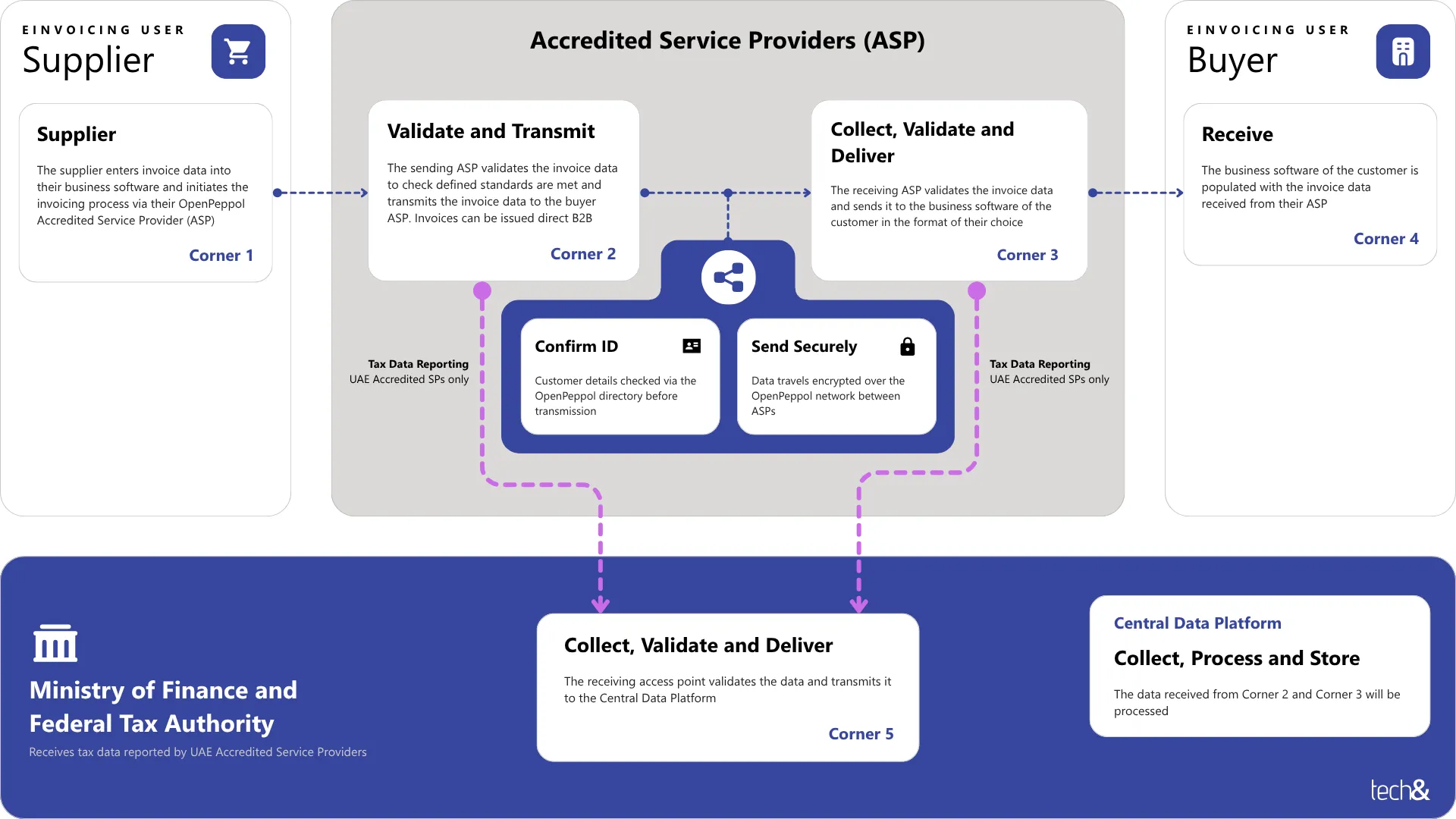
The UAE has adopted the OpenPeppol standard as part of its electronic invoicing system. The Ministry of Finance says this approach is intended to support interoperability, cross-border trade, secure data exchange and more efficient invoice processing.
The UAE model uses accredited service providers to facilitate the exchange and reporting of electronic invoices. The Ministry's four-corner model shows how a supplier's system can send an e-Invoice through an accredited service provider to the buyer's service provider, while the relevant tax data is also reported through the required channel.
For a finance manager, the important point is that Peppol is not simply another place to email an invoice.
Your ERP or accounting system needs to produce or provide the right information. Your chosen service provider needs to handle the relevant electronic exchange. The buyer's system needs to be able to receive the invoice. Data also needs to meet the applicable UAE requirements.
That makes system compatibility important.
Before choosing an approach, businesses should review:
- Whether their ERP or accounting platform can support structured invoice data
- How customer and supplier information is stored
- Whether VAT data is captured consistently
- How invoices are approved
- How invoice errors are handled
- What integration options are available
- How the chosen service provider fits into the existing technology environment
Using Peppol alone does not guarantee UAE e invoicing compliance. The complete process needs to align with the UAE framework and applicable technical requirements.
How to Move From PDF Invoices to UAE E-Invoicing
The systems and processes businesses need to prepare
The transition should start with an assessment rather than immediately buying new software.
Map how an invoice is created today. Identify which system generates it, where customer data comes from, who approves it, how tax is calculated and how the final invoice reaches the customer.
Then compare that process with the structured requirements of the UAE system.
| Current Process | E-Invoicing Requirement | What Businesses Should Do |
| PDF invoices | Structured invoice data | Review invoice generation systems |
| Manual invoice creation | Automated data exchange | Assess automation options |
| Separate accounting systems | Connected financial data | Review system integration |
| Email-based invoice delivery | Digital transmission | Prepare an appropriate e-invoicing workflow |
One of the first technical checks should be the ERP or accounting platform. Some businesses may already have much of the required financial information stored digitally but lack the integration needed to exchange it electronically.
Others may have fragmented processes. Sales may use one platform, finance another and customer information may be maintained in spreadsheets.
Those businesses may need more preparation.
The transition can generally be approached through these steps:
- Document the current process. Identify every system and person involved in creating, approving and sending invoices.
- Review invoice data. Check whether required customer, supplier, tax and transaction information is captured consistently.
- Assess ERP compatibility. Determine whether existing systems can support the relevant UAE e-invoicing requirements.
- Review integration options. Identify how the ERP or accounting system can connect to the required electronic invoicing infrastructure.
- Clean master data. Correct incomplete or inconsistent customer and supplier records before testing.
- Test invoice workflows. Check creation, validation, transmission, rejection, correction and reconciliation processes.
- Train finance teams. Staff should know how to handle exceptions instead of relying entirely on manual workarounds.
This is also where technology partners can be useful. A business may not need to replace its entire ERP system simply because e-invoicing is changing. In some cases, integration, configuration and process changes may be enough. The right answer depends on the company's existing technology stack.
For businesses assessing these changes, Tech& AI can support the technology side of the conversation by helping evaluate ERP environments, integration requirements, automation opportunities and financial data workflows.
What UAE Businesses Should Check Before 2027
A practical e-invoicing readiness checklist
The best time to discover a missing customer field or incompatible accounting workflow is before mandatory implementation, not when an invoice fails during a live transaction.
Businesses should review their readiness across finance, technology and operations.
| Area | What to Review | Why It Matters |
| Invoicing system | How invoices are generated | Determines integration requirements |
| ERP/accounting software | E-invoicing compatibility | Supports structured invoice processing |
| Tax data | VAT and invoice information | Helps maintain accurate invoice records |
| Customer data | Required billing information | Reduces invoice errors |
| Workflow | Approval and transmission process | Helps streamline compliance |
A useful internal review should cover the following areas:
Invoice and tax data
- Current invoice formats
- Invoice numbering
- Supplier and customer information
- VAT and tax-related information
- Tax calculations
- Credit notes and adjustments
- Data validation rules
Technology and integration
- ERP capabilities
- Accounting software
- Sales and billing systems
- API or integration options
- Accredited Service Provider requirements
- Data mapping
- Testing environments
Finance operations
- Invoice approval workflows
- Error handling
- Reconciliation
- Reporting
- Digital record keeping
- Staff responsibilities
Businesses should also identify where manual intervention currently occurs. A process may appear automated because an invoice is generated by software, while finance staff still manually copy information into another system or email invoices individually.
Those hidden manual steps can become bottlenecks once structured electronic invoicing is fully operational.
A few common mistakes to avoid
Businesses preparing for the UAE e invoicing mandate should avoid assuming that:
- A PDF generated by accounting software automatically qualifies as an e-Invoice.
- Buying an e-invoicing solution automatically makes the entire business compliant.
- Peppol itself is the regulator.
- Existing customer data is already clean enough for electronic invoicing.
- Every ERP integration will work in the same way.
- The mandatory timeline applies identically to every business.
The UAE's programme is phased, and requirements can evolve through official decisions and guidance. Businesses should therefore use the Ministry of Finance and FTA as their primary sources when confirming their applicable obligations.
H4: Practical Takeaway: Start With the Invoice Process, Not the Software
The biggest change coming to UAE invoicing is not simply that companies will stop sending PDFs.
The bigger shift is from invoices being treated as documents to invoices being treated as structured financial data that can be exchanged and reported electronically.
That is why a PDF invoice and a structured e-Invoice are fundamentally different. The UAE framework is built around electronic data exchange, interoperability and reporting rather than simply converting paper or Word documents into digital files.
Peppol is an important part of this infrastructure because it supports interoperability between systems and trading partners. But businesses still need to consider their ERP, accounting platform, master data, tax information, workflows and service-provider setup.
For larger businesses facing the January 2027 implementation milestone, preparation is already a live technology and operational issue. Other businesses have additional time, but they should not treat that as a reason to postpone system assessment.
A sensible first step is to map the current invoicing process and identify where structured data, integration and automation will be required.
For businesses that need help assessing their technology environment, Tech& AI can provide a technology-focused perspective on ERP integration, financial workflows, automation and e-invoicing readiness—helping teams understand what needs to change before the transition creates avoidable disruption.
Frequently asked questions
No. A PDF invoice is generally considered an unstructured electronic document rather than a structured e-Invoice under the UAE e-invoicing framework. A genuine e-Invoice contains structured invoice data that can be electronically exchanged and reported through the required infrastructure.
The UAE e-invoicing mandate introduces a phased framework requiring businesses within scope to issue, exchange, and report structured electronic invoices. Implementation dates vary depending on the type and size of the business, so companies should assess the requirements that apply to them rather than assuming a single deadline applies to everyone.
Peppol is an interoperability framework that supports the electronic exchange of structured business documents between different systems. In the UAE, Peppol standards form part of the e-invoicing infrastructure. Businesses can use the relevant service-provider and system connections to exchange structured invoices electronically.
Not necessarily. Whether an existing ERP or accounting system needs to be replaced depends on its capabilities and how it can integrate with the required e-invoicing infrastructure. Businesses should first assess their current systems, invoice data, integration options, and workflow before deciding whether configuration, integration, or a broader technology change is required.
Businesses can start by reviewing how invoices are currently created, checking ERP and accounting system compatibility, cleaning customer and supplier data, reviewing VAT information, assessing integration requirements, and testing invoice workflows. Preparing early can help identify system or process gaps before mandatory e-invoicing requirements apply to the business.
Tech& Team
Enterprise AI Experts