The UAEs transition to mandatory e-invoicing is no longer a future initiative, it's a business reality.
It Starts with One Rejected Invoice: The Reality of UAE E-Invoicing
Following the Ministry of Finances rollout, voluntary adoption began in July 2026 while mandatory implementation starts from 1 January 2027 for businesses with annual revenue of AED 50 million or more with subsequent phases extending through 2027 for other businesses and government entities. Organizations within the first phase are also required to appoint an Accredited Service Provider (ASP) by 30 October 2026 making preparation business priority rather than a technical project.
Yet, regulatory deadlines tell part of the story.
When business leaders think about UAE e-invoicing penalties, they often focus on fines and enforcement actions. In reality the greater financial impact usually comes long before any penalty is imposed. A single rejected invoice can delay customer payments, increase processing, consume finance and IT resources and trigger costly remediation efforts. Research by APQC consistently shows that invoice processing efficiency has an impact on operational costs, making every exception more expensive than organizations often anticipate.
The urgency is clear. According to research 80% of invoices worldwide are still processed manually despite digital transformation initiatives. Manual invoicing remains one of the contributors to processing delays, human error and compliance risk, precisely the challenges that mandatory e-invoicing aims to eliminate. Businesses that continue to rely on systems, spreadsheets or outdated ERP processes are significantly more likely to encounter avoidable disruptions as regulatory requirements evolve.
As the UAE advances toward mandatory e-invoicing, the objective is no longer simply to avoid UAE e-invoicing penalties. It's to minimize the hidden costs of non-compliance, from delayed cash flow and emergency ERP upgrades to increased consulting costs and operational disruption.
How Small UAE E-Invoicing Compliance Errors Become Costly
Non-compliance rarely stems from one major failure. More often, it's the accumulation of small errors that go unnoticed until they disrupt business operations.
An incorrect tax code, incomplete customer data, a missing mandatory field or a manual approval delay may seem minor in isolation, However, under a structured e-invoicing framework, these issues can result in rejected invoices, delayed payments, additional administrative effort and unnecessary operational risk.
The impact doesn't stop with the finance team. One invoice exception can create a chain reaction across the business:
- Finance spends time investigating and correcting errors.
- Accounts Receivable experiences delayed collections and cash flow disruptions.
- IT is pulled into resolving system or integration issues.
- Leadership loses visibility and confidence in processes.
Small process gaps can quickly turn into bigger business problems. That's why leading organizations see UAE e-invoicing as more than a compliance requirement. They use it to improve data quality, streamline finance operations, and strengthen governance, so small mistakes don't become costly compliance issues. The real question isn't whether errors will happen, but whether your business is ready to stop them from becoming a risk.
Beyond Penalties: The Hidden Mitigation Costs of UAE E-Invoicing
When businesses think about non-compliance, regulatory penalties are often the first concern. However, fines are only a singular part of the equation. The true cost of non-compliance collectively affects finance, operations, technology, and long-term business performance.
Understanding these costs helps organizations make decisions about investing in compliance before issues arise.

Regulatory Costs
Administrative penalties, increased audit scrutiny and corrective actions can result in financial consequences. While these costs are measurable, they often represent a small portion of the overall impact.
Operational Costs
Every rejected or delayed invoice creates additional work. Finance teams spend time correcting errors, managing exceptions and communicating with customers or suppliers, which results in reduced productivity and increased operational overhead.
Technology & Mitigation Costs
Organizations that delay preparation often face emergency ERP configuration changes, system integrations, data cleansing projects, user training and external consulting fees. These reactive investments are typically more expensive than planned implementation.
Financial Costs
Invoice delays can slow down cash collections, impact working capital and increase the cost of managing accounts receivable. Over time, these inefficiencies can influence financial performance.
Strategic Costs
Perhaps the cost overlooked most is the impact on the business itself, Leadership attention shifts from growth initiatives to issue resolutions, digital transformation projects are delayed. Customer or supplier confidence may be affected.
Key Takeaway: The cost of non-compliance isn't defined by a single penalty; it's the combined impact of operational disruption, technology remediation, financial inefficiencies and strategic distraction. Businesses that prepare early are better positioned to avoid these hidden costs while building more resilient finance operations.
Common UAE E-Invoicing Requirements Businesses Overlook
What compliance actually requires:
There's a misconception that UAE e-invoicing is simply an IT upgrade or a finance project. In reality it touches every part of the invoice lifecycle, from customer master data and tax configuration to approval workflows, ERP integrations and audit readiness.
This is where many businesses encounter unexpected challenges. They focus on meeting the regulatory deadline but overlook the operational changes required to support it.
The common roadblocks include:
- Treating compliance as an IT initiative instead of a business-wide transformation.
- Poor data quality, leading to invoice validation failures and manual corrections.
- Disconnected systems, that create inconsistent financial data across departments.
- Legacy ERP platforms that require customization or upgrades.
- Leaving preparation too late, resulting in rushed implementations, limited testing and higher mitigation costs.
The organizations that succeed don't necessarily have the largest budgets or the newest technology. They have a plan that aligns people, processes and systems well before compliance deadlines arrive.
That's where a proven implementation framework makes the difference.
The 5C Framework for UAE E-Invoicing Compliance: From Readiness to Resilience

From UAE E-Invoicing Compliance to Competitive Advantage: A Readiness Checklist
A compliance framework provides direction; Successful compliance depends on execution.
Every organization has a starting point. Some operate on cloud ERP platforms, while others rely on legacy systems, manual processes or disconnected applications. Although the regulatory destination is the same, the journey to compliance is unique for every business.
That's why successful organizations don't begin with software. They begin with an understanding of their current state, the risks that exist across their finance operations and the steps required to close those gaps with minimal disruption.
What Effective Compliance Implementation Looks Like
Preparing for UAE e-invoicing requires more than technical deployment. It demands an approach that aligns business processes, technology and people.
A trusted implementation partner should help organizations:
- Assess compliance readiness by identifying process and technology gaps.
- Develop a roadmap aligned with regulatory timelines and business priorities.
- Optimize finance processes to reduce manual effort and improve operational efficiency.
- Strengthen data quality by ensuring customer, supplier and tax information is accurate and complete.
- Configure Integrate ERP systems with Accredited Service Providers (ASPs) and other business-critical applications.
- Validate and test processes go-live to minimize disruption.
- Continuously monitor compliance performance as regulations and business requirements evolve.
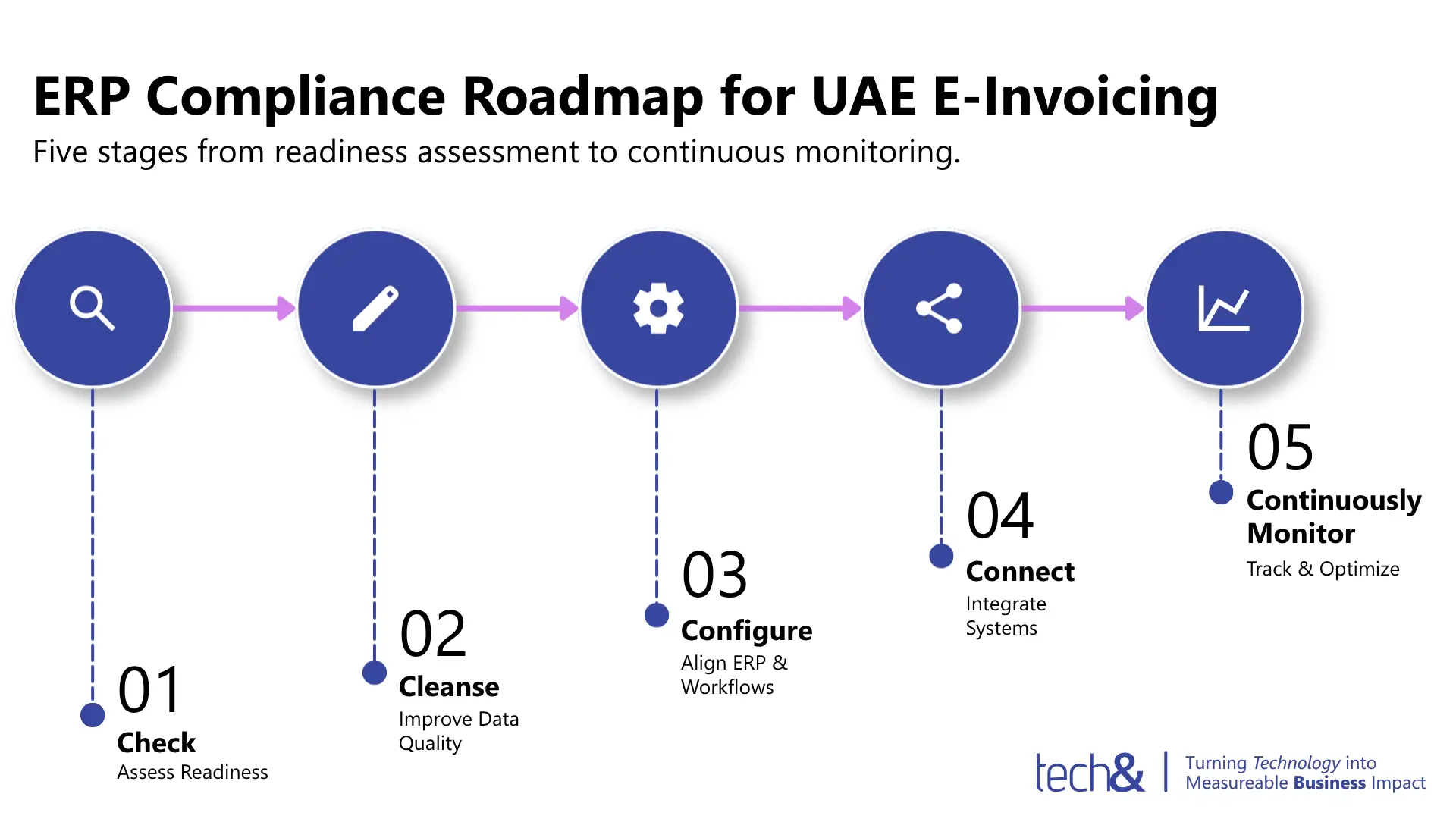
Notice that none of these activities are solely about technology. They're about creating a finance function that’s resilient, efficient and prepared for long-term regulatory change.
This is the philosophy behind our approach.
Instead of treating UAE e-invoicing as a standalone implementation project, we work with organizations to modernize finance operations through strategic planning, process optimization and technology enablement. Where Microsoft Dynamics 365 is the right fit, we leverage its capabilities to automate workflows, improve financial visibility and support sustainable compliance, but the technology always serves the strategy, not the other way around.
Questions Every Business Leader Should Ask About UAE E-Invoicing Requirements
If implementation had to start next month, would your organization be ready?
As the UAE moves toward compulsory e-invoicing, business leaders should be asking themselves not just whether they'll be compliant but whether their organization is truly prepared for what’s ahead. Companies that have looked at their processes, checked their data and planned implementation are much better placed to meet regulatory requirements without causing unnecessary problems or increasing mitigation costs.
- If an auditor requested every invoice issued in the 12 months how confident would you be in your data?
- Is your ERP supporting compliance or creating more work for your finance team?
- Your ERP should simplify compliance, not create manual effort. If your teams rely on spreadsheets, workarounds or repetitive data corrections, your systems may be introducing redundant risk instead of reducing it.
- Are you preparing for the deadline or for the business changes that come with it?
- Meeting a compliance deadline is the only first milestone. The bigger challenge is building finance processes that remain efficient, scalable and adaptable as regulations continue to evolve.
- Would your finance team describe your invoice process as automated or dependent on workarounds?
Being ready is not measured by intent, It is measured by execution. The answers to these questions show a clearer picture of how ready your organization is than any list ever could. More importantly they help change the conversation from "Are we following the rules?" to "Are we building a finance team that is ready for what comes next?"
Prepare for UAE E-Invoicing Today Before Compliance Costs Rise
UAE e-invoicing is more than a new rule. It is a change in how businesses manage finances, data and observance.
The idea behind our 5C Compliance Framework is to help companies go beyond just short-term compliance by using structured implementation combined with deep knowledge of ERP and finance. When Microsoft Dynamics 365 aligns with your company requirements, we use it as a tool to automate processes, improve financial visibility and support sustainable compliance.
The question is no longer whether UAE e-invoicing will affect your business. It is whether you will be prepared on your own terms or under the pressure of regulatory deadlines.
The companies that act now will not just avoid the cost of non-compliance. They will be the ones best positioned to confidently handle the change with more efficiency and turn compliance into a long-term competitive advantage.
If you are looking at how ready your organization is, now is the time to start talking. Whether you are checking your system, planning for regulations or thinking about how Microsoft Dynamics 365 fits in, our team is here to help you go through the process with confidence.
Ready for UAE E-Invoicing Compliance?
Protect your workflows under the new UAE e-invoicing compliance rules.
Talk to our ExpertsFrequently asked questions
Automated e-invoicing reduces manual errors, speeds up invoice processing, and simplifies compliance. It also improves cash flow, lowers costs, and increases finance team productivity.
Yes. The UAE is introducing mandatory e-invoicing in phases, with businesses expected to comply as the framework is rolled out by the government.
Dynamics 365 pricing depends on the applications and licenses you need, starting from around US$80/user/month (or approximately AED 258/month for Business Central Essentials in the UAE), excluding implementation and customization.
E-invoicing automates invoice creation, validation, approvals, and reconciliation, reducing repetitive manual work. This allows your finance team to spend more time on strategic tasks instead of administrative processing.
The best time is before your compliance deadline. Early preparation gives your team enough time to review data quality, test integrations, train users, and avoid expensive last-minute changes or business interruptions.
Tech& Team
Enterprise AI Experts