The UAE e-invoicing mandate is replacing legacy PDFs with system-to-system Peppol PINT-AE XML reporting. Upgrading enterprise ERPs to handle the 5-corner architecture requires strict data mapping across 51 mandatory tax fields. Read our technical breakdown on bridging your legacy software to Accredited Service Providers without disrupting finance workflows.
The UAE E-Invoicing Mandate: What Tech Leaders Need to Know
The UAE is shifting its entire tax and trade ecosystem to automated digital reporting. Under new mandates from the Ministry of Finance (MoF) and the Federal Tax Authority (FTA), standard paper documents, emailed PDFs, and static spreadsheets won't qualify as legal tax invoices anymore.
Instead, e-invoicing in UAE demands direct, system-to-system transmission of structured data through the international Peppol network. If your software can't output validated XML directly to a gateway, your business won't be compliant.
For CTOs, ERP architects, and engineering teams, the implementation timeline leaves very little room for delay:
- July 1, 2026: The voluntary pilot window opens for live system testing.
- October 30, 2026: Deadline for large enterprises ($\ge$ AED 50M turnover) to contract an Accredited Service Provider (ASP).
- January 1, 2027: Mandatory compliance goes live for large enterprises.
- July 1, 2027: All remaining VAT-registered businesses ($<$ AED 50M) go live.
- October 1, 2027: Mandatory coverage expands to Business-to-Government (B2G) transactions.
Achieving UAE e-invoicing compliance means fixing how your primary financial database creates, validates, and routes every single transaction.
"True regulatory compliance is not achieved by patching legacy output. It requires building structured data integrity at the system of record."

Understanding the UAE 5-Corner Architecture
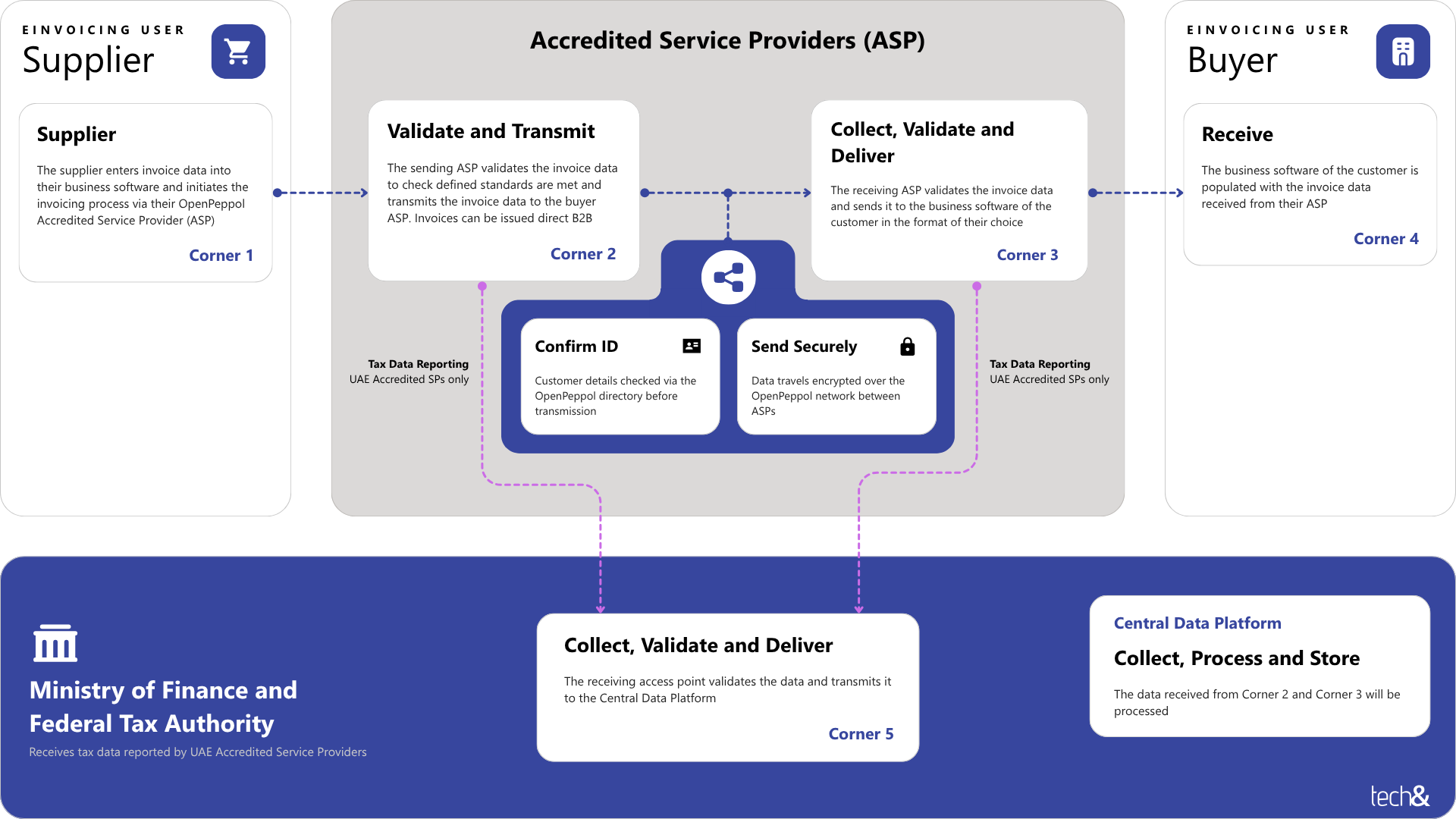
Most regional neighbors like Saudi Arabia rely on a centralized "clearance" engine where every invoice hits government servers first. The UAE took a different route. Peppol UAE uses a Decentralized Continuous Transaction Control and Exchange (DCTCE) model—better known as the 5-Corner Model.
Here is how data moves across the five nodes:
Corner 1: The Supplier System (Your ERP)
This is your core system—SAP, NetSuite, Dynamics, Odoo, or a custom stack. It creates the raw billing data when an invoice triggers.
Corner 2: Supplier Accredited Service Provider (ASP)
Your licensed gateway. It takes your raw ERP data, translates it into compliant format, checks it against local rules, and fires it across Peppol.
Corner 3: Buyer Accredited Service Provider
The receiving ASP. It ingests the incoming file, runs its own checks, and delivers it straight to the buyer.
Corner 4: The Buyer System
The buyer’s accounting engine, which reads the file automatically for accounts payable matching.
Corner 5: The Federal Tax Authority (FTA) Central Platform
While Corner 2 passes data to Corner 3, an asynchronous copy shoots over to the FTA for tax audit tracking.
The Technical Core: What is Peppol PINT-AE?
At the center of Peppol e-invoicing in the Emirates sits PINT-AE (Peppol International Invoice – UAE specification). It uses standard UBL 2.1 XML as a base, but layered with specific rules for UAE tax legislation and Ministerial Decisions 243 & 244.
Your engineering team needs to account for three major technical requirements:
- 51 Mandatory Fields: Standard tax invoices require 51 specific data points. You must include TRNs using the 0235 Peppol prefix, place-of-supply tags, tax breakdown arrays, and exact AED conversions for foreign currencies.
- Schematron Rules: Every payload faces strict programmatic checks (.sch files). If a field calculation is off by even a fraction of a fill, the gateway rejects the file before it ever leaves your server.
- Strict Code Lists: Generic strings won't work. ISO 4217 for currencies, ISO 3166-1 alpha-2 for countries, and UN/ECE Rec 20 for units of measure are non-negotiable.

5-Step ERP Upgrade Roadmap
If you decide to handle compliance directly inside your database, here is the exact development path your team should take:
1. Data Schema & Gap Analysis
Audit your existing tables against the PINT-AE semantic model. Most legacy setups lack required fields like EndpointID tags with scheme 0235, Free Zone flags, or explicit exemption reference codes.
2. Master Data Normalization
Clean your database now. Run automated scripts to verify vendor and client TRNs against the official FTA registry. Replace custom unit descriptions with standard UN/ECE codes across all product tables.
3. Payload Generation Engine
Write a lightweight service that extracts invoice records, maps them into nested UBL 2.1 XML nodes, and validates them against local Schematron rules locally.
4. ASP Connection Layer
Build authenticated REST API or mutual-TLS channels between your internal middleware and your chosen ASP gateway.
5. Pilot Phase Sandbox Testing
Take advantage of the voluntary pilot period starting July 2026. Run live transactional payloads through the OpenPeppol testbed so you can catch mapping errors early.

Empower Your Business for Success
The UAE Ministry of Finance and Federal Tax Authority are phasing out PDFs and paper billing in favor of mandatory electronic tax reporting. Achieving full UAE e-invoicing compliance requires exchanging structured, validated tax files across the official compliance network using the approved multi-corner architecture. Integrating compliance middleware developed by techand.ai bridges legacy ERPs directly to the system, automates tax file conversion, enforcing all mandatory UAE data fields, and routing transactions via Accredited Service Providers without disrupting daily finance workflows.
Ready for UAE E-Invoicing Compliance?
Protect your workflows under the new UAE e-invoicing compliance rules.
Talk to our ExpertsFrequently asked questions
The UAE e-invoicing mandate requires all VAT-registered entities to create, transmit, and retain transactional billing records in a structured electronic format under the official Electronic Invoicing System (EIS).
Standard PDFs, Word documents, scanned images, and paper receipts are non-compliant for official tax reporting. All valid tax invoices must exist as structured UBL 2.1 XML files.
Peppol PINT-AE (Peppol International Invoice – UAE specification) is the official data standard mandating 51 specific tax and transaction fields for electronic tax invoices across the Emirates.
The 5-corner model connects the seller's ERP (Corner 1) to a seller Accredited Service Provider (Corner 2), which transmits the invoice payload across the Peppol network to the buyer's provider (Corner 3) and buyer ERP (Corner 4), while reporting tax data asynchronously to the Federal Tax Authority platform (Corner 5)
Techand.ai serves as an intelligent compliance middleware layer. It transforms standard JSON or database outputs into validated electronic tax files, applies built-in UAE tax validation logic, and connects directly to Accredited Service Providers without disrupting existing core software workflows.
Tech& Team
Enterprise AI Experts