





Choosing e-invoicing software is no longer simply a question of replacing paper or PDF invoices with a digital alternative. For a UAE CFO, the more important question is: Can the software create structured invoices, connect with the right network, integrate with existing finance systems, maintain proper controls, and support the business as requirements evolve?
That distinction matters because a PDF invoice is not the same as an electronic invoice under the UAE framework. The Federal Tax Authority defines an e-Invoice as structured invoice data that is issued and exchanged electronically and reported electronically. PDFs, Word documents, scans, images, and invoices sent by email are not considered e-Invoices.
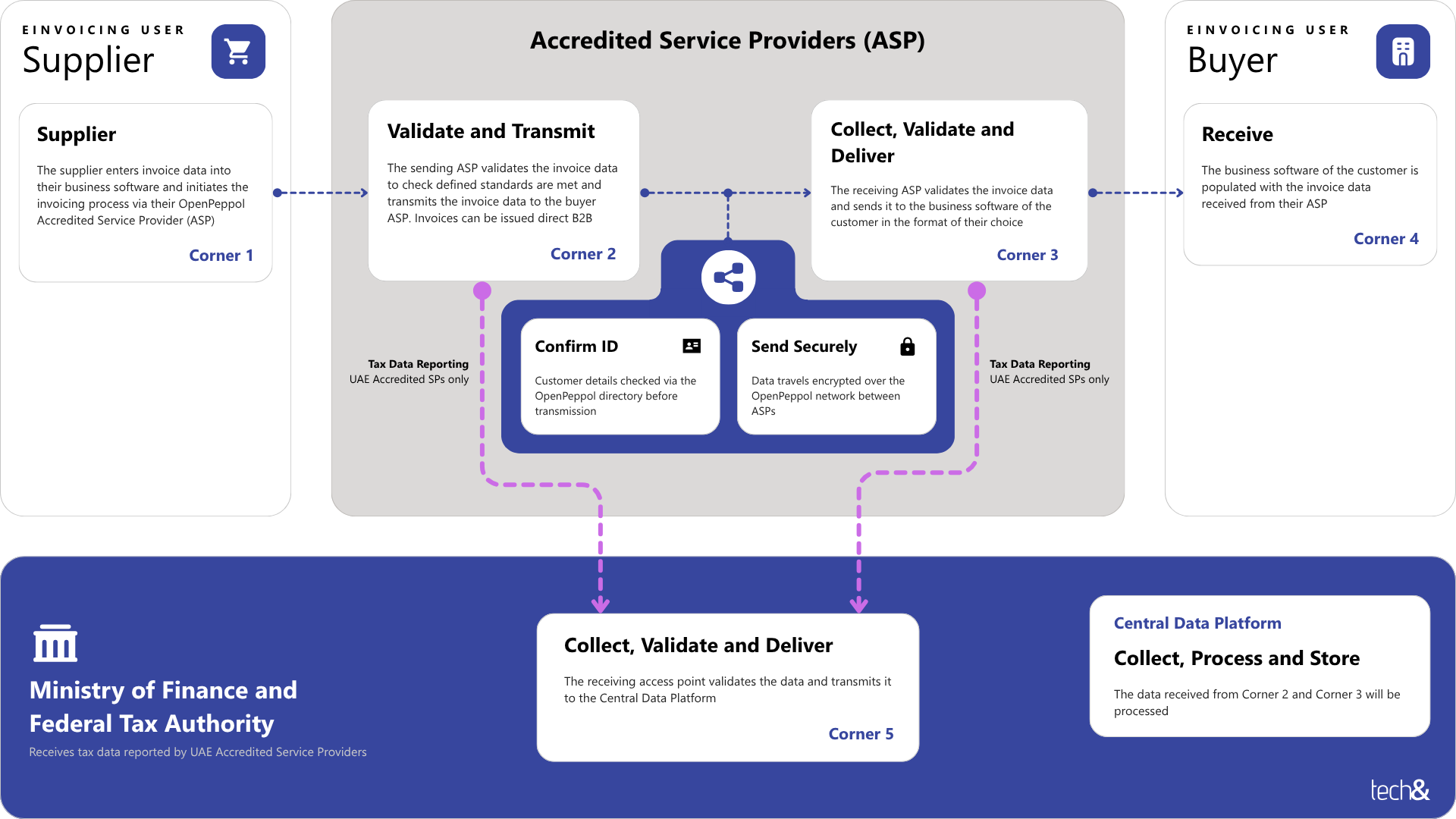
The UAE's model is based on the international OpenPeppol standard, with electronic invoices exchanged through accredited service providers.
For CFOs evaluating e invoicing UAE solutions, this means software selection needs to cover more than invoice creation. Compliance, Peppol connectivity, automation, ERP integration, security, reporting, and scalability all need to be considered together.
Here are the key features finance leaders should evaluate before selecting an e-invoicing platform.
Why Peppol E-Invoicing Software Matters for UAE Businesses
What CFOs need to understand about the move to structured e-invoicing
Traditional invoicing often involves creating an invoice in an accounting system, exporting it as a PDF, emailing it to the customer, and then manually tracking whether it was received and processed. While this may be digital, it does not make the invoice structured electronic data.
With structured e-invoicing, the information within an invoice is formatted so that systems can process it electronically. This supports automated exchange between businesses and the relevant service providers rather than relying on people to open documents, read information, and re-enter data.
Peppol e-invoicing adds the network and standards layer to this process. Peppol provides a standardized framework for exchanging electronic business documents. In the UAE, the e-invoicing model uses accredited service providers and the Peppol network to support electronic invoice exchange.
For a CFO, the software decision therefore has several dimensions:
- Compliance: Can the platform support applicable UAE e-invoicing requirements?
- Operations: Can it reduce repetitive invoice processing?
- Integration: Can it connect with the ERP and accounting environment already in use?
- Control: Can finance teams monitor invoice activity, approvals, and errors?
- Scalability: Can the platform handle higher transaction volumes and organizational complexity?
This is why selecting software based only on its ability to generate invoices can create problems later. A finance team may end up with another disconnected system, duplicate data entry, manual reconciliation, or limited visibility into invoice status.
The better approach is to treat e-invoicing as part of the broader finance technology architecture.
Core Peppol E-Invoicing Features CFOs Should Prioritize
The essential features that make e-invoicing software useful beyond compliance
A strong e-invoicing platform should help finance teams manage the complete invoice lifecycle rather than simply produce an electronic document.
Structured invoice generation is the starting point. The platform should be capable of producing machine-readable invoice data in the formats and specifications applicable to the UAE framework. The Ministry of Finance has published mandatory invoice field requirements alongside its electronic invoicing guidelines.
Peppol connectivity is another critical consideration. CFOs should understand how the provider connects their business to the Peppol network and how invoices are sent and received through the applicable accredited service provider arrangement.
Invoice validation is equally important. Before an invoice is transmitted, software should be able to identify missing, inconsistent, or incorrectly formatted information. This can help prevent avoidable errors from reaching customers or downstream systems.
Other useful capabilities include:
- Automated invoice transmission
- Real-time or near-real-time invoice status tracking
- Error notifications and exception handling
- Credit note and invoice adjustment support
- Digital invoice records
- Searchable invoice history
- Approval workflows
- Audit trails
- Multi-user access and role-based permissions
| Feature | What It Does | Why CFOs Should Care |
| Structured invoicing | Creates machine-readable invoice data | Supports standardized processing |
| Invoice validation | Checks invoice information before transmission | Helps reduce errors |
| Peppol connectivity | Enables electronic document exchange through the network | Supports interoperability |
| Workflow automation | Automates repetitive finance tasks | Reduces manual effort |
| Audit trail | Records invoice activity | Improves visibility and accountability |
None of these features should be treated as an automatic guarantee of regulatory compliance. The software, configuration, service provider arrangement, and business processes all need to align with the applicable UAE framework.
The CFO's objective should be to select a platform that makes compliant processes easier to operate and control rather than adding another manual step to the finance function.
UAE E-Invoicing Requirements Software Must Support
Compliance-focused capabilities CFOs should evaluate before choosing a platform
The first step is to distinguish between mandatory regulatory requirements and recommended software capabilities.
The UAE framework defines e-Invoices as structured electronic invoice data and provides mandatory field requirements that businesses need to consider. The Ministry of Finance also states that businesses should identify changes required in their accounting, ERP, and invoicing systems as part of preparing for e-invoicing.
This makes compliance capability a software-selection issue, but CFOs should avoid assuming that every feature marketed by a vendor is itself a legal requirement.
When assessing UAE e invoicing requirements, look at whether the platform can support:
- Required invoice information
- Structured invoice data
- Applicable tax and VAT information
- Invoice validation
- Data integrity controls
- Electronic transmission
- Record keeping
- Auditability
- Integration with financial systems
- Updates as the UAE framework evolves
The same approach applies when reviewing UAE e invoice requirements. Instead of asking only, "Can this software create an invoice?", ask whether the complete process from invoice creation to transmission, record keeping, exception handling, and reporting can be managed effectively.
The UAE framework is also evolving. The Ministry of Finance has issued amendments to the implementation decisions, including an amendment that moved the ASP appointment deadline for businesses with revenue of AED 50 million or more to 30 October 2026, while retaining the 1 January 2027 implementation date for that category.
That is a useful reminder for CFOs: software selection should account for regulatory updates rather than being based on a one-time interpretation of today's requirements.
The Ministry also advises businesses to onboard with an Accredited Service Provider, test end-to-end electronic invoice exchange and reporting, and establish processes for error resolution and ongoing changes.
ERP Integration and Automation Features CFOs Should Look For

Connecting e-invoicing with ERP and finance workflows
An e-invoicing platform should not become an isolated application sitting beside the ERP.
For many finance teams, the real value comes from connecting invoice generation and exchange with the systems already holding customer, supplier, tax, sales, purchasing, and accounting information.
A good e invoicing software UAE evaluation should therefore include ERP and accounting integration from the beginning.
For example, when a sales transaction is completed, the relevant invoice information should ideally flow from the business system into the e-invoicing process without requiring finance staff to manually copy the same information into another platform.
Integration can also support accounts payable and accounts receivable workflows. Incoming invoices can potentially be routed into the appropriate finance process, while outgoing invoices can move through approval, transmission, status tracking, and reconciliation workflows.
Important capabilities to examine include:
- ERP integration
- Accounting software integration
- API availability
- Customer and supplier data synchronization
- Automated invoice creation
- Tax information flow
- Accounts payable and receivable workflows
- Configurable approval processes
- Automated notifications
- Reconciliation support
- Reporting dashboards
- Data synchronization
| Integration Area | What to Look For | Business Benefit |
| ERP | Reliable system integration | Centralized financial data |
| Accounting | Automated invoice data flow | Less manual entry |
| Customer data | Synchronization | Fewer data errors |
| Approval workflows | Configurable approvals | Better financial control |
| Reporting | Finance dashboards | Improved visibility |
For CFOs, integration is ultimately about control and efficiency. If invoice data has to be entered twice, the company has created another opportunity for errors. If invoice status is unavailable within the finance workflow, teams may also spend unnecessary time checking systems manually.
The technical question is therefore not simply whether an API exists. It is whether the integration supports the company's actual processes and data architecture.
Security, Reporting and Scalability Features
Choosing software that can support finance teams as the business grows
Compliance and integration may get most of the attention during an e-invoicing project, but security and scalability can determine whether the platform remains useful after implementation.
Finance systems handle commercially sensitive information. CFOs should therefore understand how the platform manages user permissions, authentication, access controls, audit logs, backups, data protection, and invoice history.
Security should also be considered when assessing the service provider itself. UAE accreditation requirements for e-invoicing service providers include information security considerations, and the Ministry's accreditation process references controls such as encryption, multi-factor authentication, security monitoring, ISO/IEC 27001, and business continuity.
Reporting is another area worth examining. Finance leaders should be able to retrieve invoice records, investigate exceptions, monitor transaction activity, and generate useful reports without relying entirely on technical teams.
Before signing up, CFOs should ask the provider:
- How are user roles and permissions configured?
- What audit information is retained?
- How are invoice records backed up and retrieved?
- How are failed or rejected invoices identified?
- What reporting dashboards are available?
- How does the platform handle higher invoice volumes?
- Can additional entities or locations be added later?
- What happens if the business changes ERP systems?
- What support is available during implementation and after go-live?
- How are regulatory or technical updates communicated and implemented?
Scalability deserves particular attention for growing groups. A platform that works well for one entity and a few thousand invoices may need a very different architecture when the business operates across multiple entities, locations, business units, or significantly higher transaction volumes.
The goal is not to buy the biggest platform available. It is to avoid selecting a system that becomes restrictive as the business grows.
How to Evaluate E-Invoicing Software in the UAE
A practical CFO checklist for comparing software providers
Price is only one part of the decision. A lower subscription cost can become expensive if the platform requires extensive manual work, difficult integration, additional middleware, or frequent technical intervention.
| A better evaluation considers the full cost and operational impact of the solution.Evaluation Area | Questions CFOs Should Ask |
| Compliance | Can the platform support applicable UAE e-invoicing requirements? |
| Peppol | How does the platform handle Peppol e-invoicing? |
| Integration | Can it connect with our ERP and accounting systems? |
| Automation | Which manual finance processes can it automate? |
| Security | What access controls and audit capabilities are available? |
| Scalability | Can it support higher invoice volumes and additional entities? |
| Support | What implementation and ongoing support is provided? |
CFOs should also assess the provider's status and capabilities carefully. The Ministry of Finance maintains a list of accredited e-invoicing service providers, and accreditation is tied to the UAE's applicable e-invoicing framework.
A practical evaluation process can follow these steps:
- Map the current invoice process. Identify how invoices are created, approved, sent, received, stored, and reconciled today.
- Document system dependencies. List the ERP, accounting, CRM, procurement, tax, and other systems that need to exchange invoice information.
- Define compliance requirements. Separate confirmed regulatory requirements from optional software features.
- Test integration. Do not rely only on a product demonstration. Validate how invoice data will actually move between systems.
- Test exceptions. Ask what happens when an invoice fails validation, is rejected, needs adjustment, or requires a credit note.
- Assess total cost of ownership. Consider implementation, integration, support, user access, future scaling, and ongoing maintenance.
- Review the provider relationship. Understand support responsibilities, update processes, service commitments, and escalation procedures.
For UAE businesses, the right solution will vary. A company with a simple accounting environment may have different needs from a group running several ERP systems across multiple entities.
The important point is to evaluate UAE electronic invoicing as part of the broader finance operating model rather than treating it as a standalone invoice-generation project.
Practical takeaway for UAE CFOs
E-invoicing software is more than an invoice generator. The right platform needs to support structured invoice processing, Peppol connectivity, appropriate controls, ERP and accounting integration, automation, reporting, security, and future scalability.
CFOs should also keep the distinction between regulation and software functionality clear. Peppol connectivity is an important part of the UAE model, but Peppol alone does not mean that a business has addressed every applicable requirement. The same applies to any individual software feature.
The strongest selection process starts with the company's existing systems and workflows, then evaluates which platform can support the required electronic invoicing process without creating unnecessary manual work.
For businesses assessing their next step, Tech& AI can support the broader technology conversation around e-invoicing, ERP integration, finance automation, and business process requirements. The focus should be on choosing an architecture that fits the business today while remaining practical as its finance operations evolve.
Frequently asked questions
Peppol e-invoicing is a standardized way of exchanging structured electronic invoices through the Peppol network. In the UAE, the e-invoicing framework uses Peppol standards and Accredited Service Providers to support electronic invoice exchange between businesses.
UAE businesses should look for features such as structured invoice generation, Peppol connectivity, invoice validation, automated transmission, approval workflows, audit trails, reporting, security controls, and integration with existing ERP and accounting systems. The right features depend on the business's systems and operational requirements.
Yes. E-invoicing software can be integrated with ERP and accounting systems to automate invoice creation and data exchange. Integration can help reduce duplicate data entry, improve data consistency, and connect invoicing with accounts payable, accounts receivable, approval, and reconciliation workflows.
No. Using Peppol-compatible software does not by itself guarantee compliance with all applicable UAE e-invoicing requirements. Compliance also depends on correct system configuration, accurate invoice data, appropriate business processes, and meeting the requirements applicable to the business.
CFOs should evaluate software based on Peppol support, UAE e-invoicing compatibility, ERP integration, automation, security, reporting, scalability, implementation requirements, vendor support, and total cost of ownership. The software should fit the company's existing finance systems and be capable of supporting future business requirements.
Muhammad Aarish
System Architect